
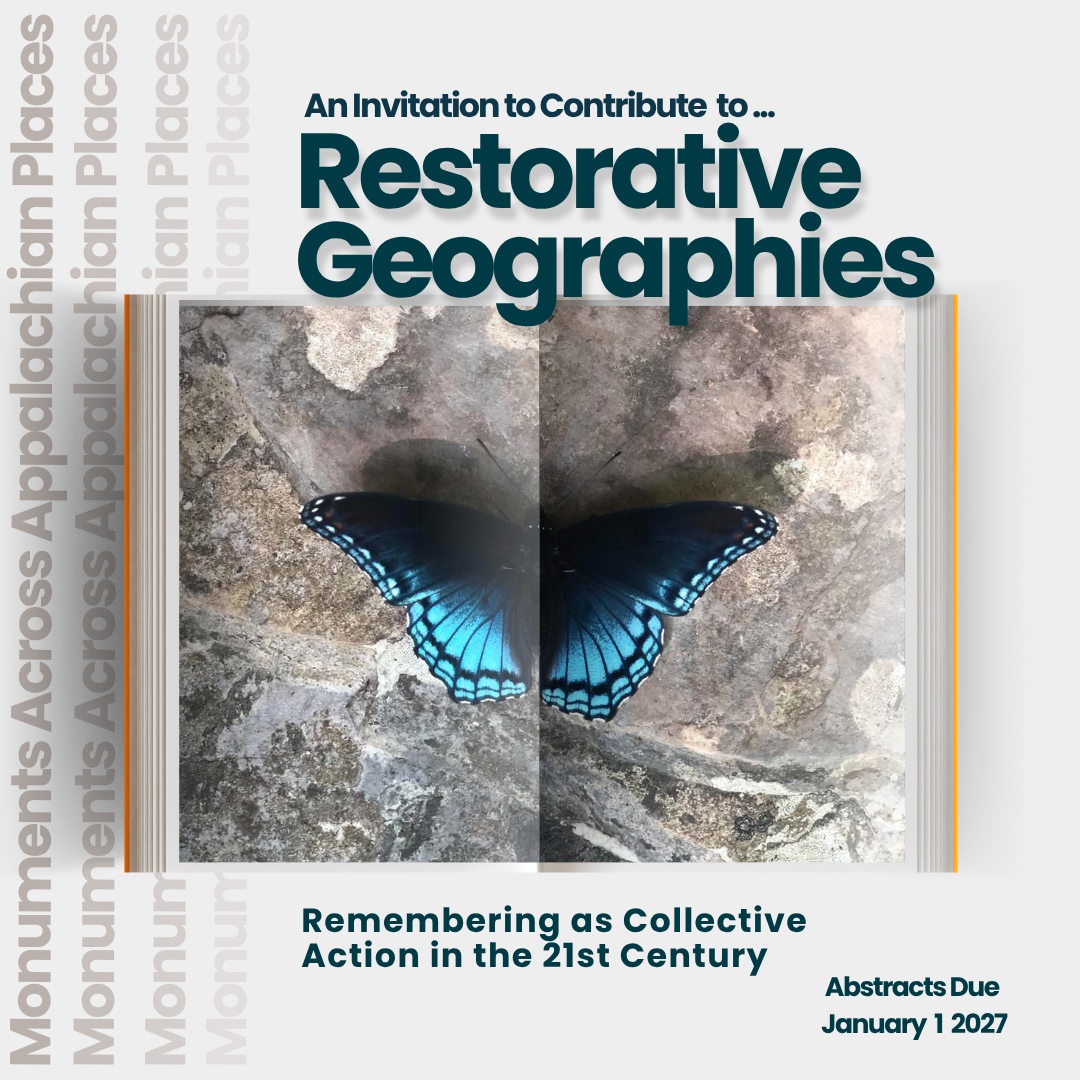
Restorative Geographies: Remembering as Collective Action in the 21st Century
We invite extended abstract submission between 500 – 1000 words for consideration in the Restorative Geographies edited volume.
We encourage abstracts from artists, researchers, educators, and other kinds of memory keepers
Communities across the globe are experiencing environmental devastations, political violence and upheaval, mass displacement and migration, ongoing efforts of colonial dispossession and extraction, racism, and erasure. In times of crisis in the 21st Century, memory work becomes a form of public health and reshapes geography. Communities build memorials, document oral histories, preserve landscapes, occupy threatened places, perform rituals, create archives, plant gardens, stage performances, organize mutual aid, and tell stories that insist on remembrance. These acts do more than commemorate experiences, they create unique geographies for collective survival, belonging, accountability, restoration, resistance, and joy.
As in Pile & Keith’s work Geographies of Resistance, we acknowledge geography as illustrative of power relationships and that geographic resistance efforts “occupy, deploy, and create alternative spatialities from those defined through oppression and exploitation.” These locations of resistance are informed, created, and sustained by memory work. Restorative Geographics begins with the premise that memory is not an act of preservation, but one of resistance and survival. Memory work thus shapes our physical and social geographies.
This volume is interested in memory work and geography construction that challenge/resist during times of crisis, asking the critical question: What does memory-making and geography construction make possible in moments marked by political polarization, deliberate distortions of historical records, and growing inequities? Restorative Geographies moves beyond just identification of locations of resistance, but details the underlying nature of memory in empowering people and communities.
Within this frame, we invite scholars, artists, practitioners, activists, and community collaborators to examine memory-making as a practice of (re)constructing geography, serving as both collective resistance and care. We seek contributions that understand memory and geography not as static records, but as an ongoing public practice shaped by relationships between people and places.
We ask potential authors to question:
How memory work functions as an intervention into public life? What are the relationships between memory, geography, health, justice, and community? How do acts of remembrance support healing, environmental stewardship, democratic participation and collective action? How do communities challenge dominant memory sites and narratives? What responsibilities accompany the work of remembering? How might collective acts of remembrance help communities imagine and enact more just futures? What does this moment calls for: in the 21st Century, how collective action/monument building makes this work possible?
Topics may include, but are not limited to:
Community-based memory projects
Place-making and public health
Indigenous, Black, immigrant, and diasporic memory practices
Memory activism and artivism
Case studies for public memory initiatives, contested or completed
If you would like to propose a chapter, please share a tentative title and concise description/outline of the potential chapter (500-1000 words). Please ensure your proposal details a form of memory work/collective action, how that work/action exists within the present time, how it re(shapes) geographies, and the result of shifting geographies.
The edited volume is currently at the proposal stage, and will be shaped by selected abstracts. We expect full chapters will be roughly 5000 words, including all elements. Chapters will go through a review with the editing team.
If you are unable to submit an abstract, but would like to be involved or know others who may be interested, please reach out.
Proposals must be submitted by January 1st, 11:59 PM, 2026 to Dr. Jacob E. Robinson at j-rob@vt.edu.
For questions email j-rob@vt.edu